The GIA Seven Pearl Value Factors
The GIA Seven Pearl Value Factors provide a structured example of how classification can be applied in practice. They separate value into independently evaluated components rather than combining them into a single grade.
The seven factors are: Size, Shape, Color, Luster, Surface Quality, Nacre Quality, and Matching.
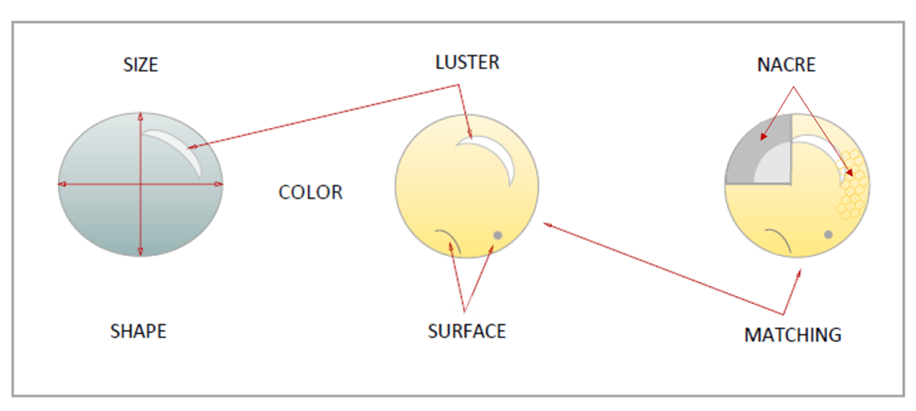
Diagram illustrating the GIA 7 Pearl Value Factors. Illustration credit: GIA.
Size
Size is stated in millimeters and may also be expressed by weight. Measurements are typically recorded to two decimal places, and pearls are often grouped in half-millimeter or full millimeter increments in the trade.
Each pearl type has a typical size range and, in some cases, an extended range. Size is influenced not only by cultivation time, but also by water temperature, nutrition, metabolism, and farming practices. Larger does not automatically mean better. In some categories, smaller pearls may display stronger luster or better overall proportion in finished jewelry.
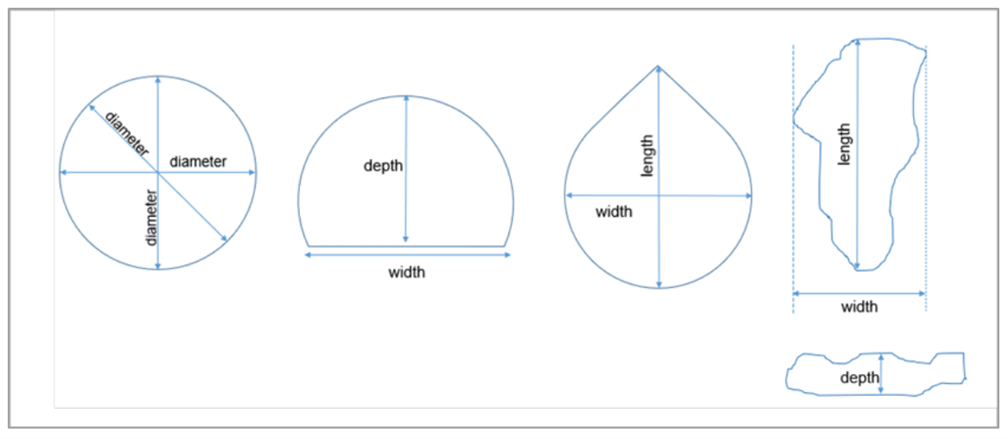
Pearl size measurement for different shapes. Illustration credit: GIA..
Shape
Shape is described using standardized terms such as round, near-round, oval, button, drop, semi-baroque, and baroque. These fall broadly into spherical, symmetrical, and irregular categories.
Round pearls are often preferred because of their rarity, symmetry, classic appearance, ease of matching, and suitability for traditional jewelry settings. Baroque pearls are evaluated for character, balance, beauty, and how well their shape works in jewelry.
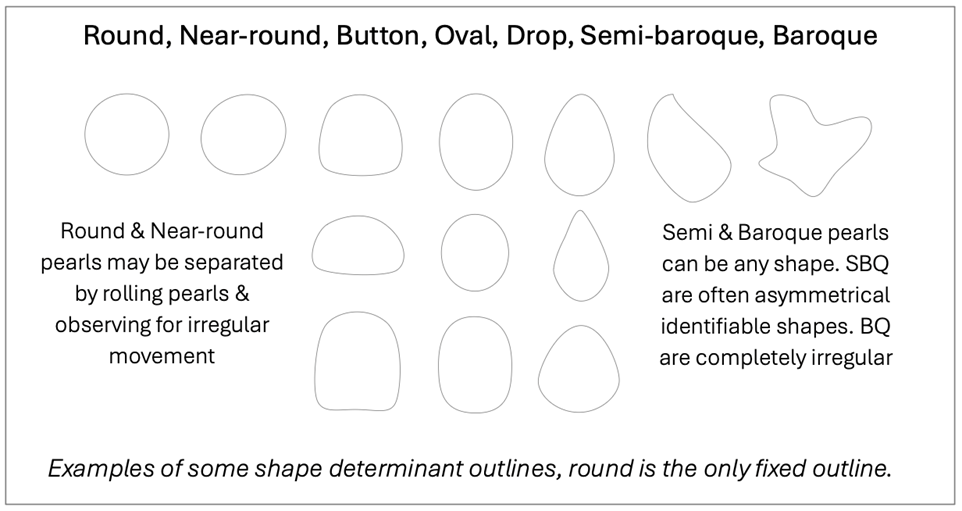
Examples of the seven predominant pearl shapes. Illustration credit: GIA.
Color
Color consists of three components: bodycolor, overtone, and orient.
Bodycolor is the dominant hue and includes considerations of tone and saturation.
Overtone is a translucent color that appears to overlay the bodycolor, while orient refers to iridescent color effects that appear to move across or beneath the surface.
Color is influenced by donor mantle tissue, host biology, and environmental conditions. Some colors are pigment-based. Others result from structural interaction within the nacre.
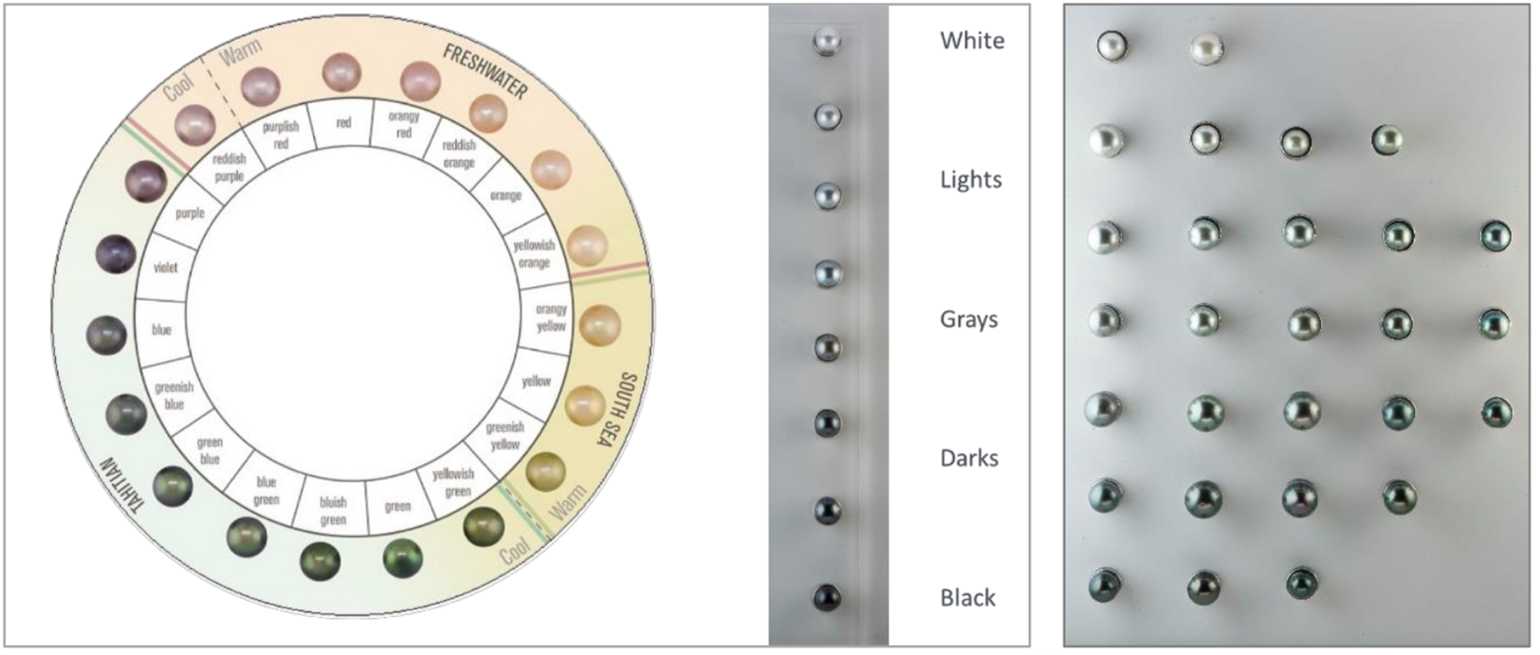
GIA Hue circle, Neutral tonal scale, and Cool color grid. Images credit: GIA.
Luster
Luster refers to the quantity and quality of light reflected from or near a pearl's surface. It is often the most important value factor as it reveals the quality of a pearl's nacreous structure and directly affects its visual impact.
It is typically described on a scale ranging from Excellent to Poor. At the highest level, reflections appear bright and sharply defined. At lower levels, reflections become diffuse or blurred.
Surface Quality
Surface quality refers to visible characteristics confined to the exterior of the pearl. Evaluation considers the size, number, nature, location, and visibility of these features. Surface is typically described on a range from Clean to Heavily Spotted.
Minor surface characteristics are expected in most pearls. Surface quality becomes more significant as pearl size increases and as the pearl moves closer to finished jewelry use, where blemishes are more visible and less easily concealed.
Nacre Quality
Nacre quality refers to the continuity, thickness, and condition of the nacre layer. Continuity describes smooth, uninterrupted layering. Thickness and condition should be evaluated within the context of pearl type.
In bead-nucleated pearls, nacre thickness can directly affect durability. In tissue-nucleated pearls, overall structure and layering help determine long-term stability.
Nacre underlies many visible value factors. Luster, surface appearance, and color expression all depend on nacre quality.
Matching
Matching applies to strands, pairs, and multi-pearl jewelry. It evaluates uniformity in size, shape, color, luster, surface quality, nacre quality, and drilling alignment. Matching is a human-driven process, and its difficulty increases as pearl size, quality, and rarity increase.
A well-matched strand, pair, or set can command a premium because it requires careful selection across multiple value factors.
Applying the Seven Value Factors
The same value factors apply to all nacreous cultured pearls. However, the standards used to evaluate them are not identical across types.
Size, shape, and color can be described using broadly consistent measurement systems. Luster, surface quality, nacre quality, and matching require type-specific reference standards. Akoya, South Sea, Tahitian, and freshwater pearls differ biologically. Their inherent characteristics must be evaluated within the context of their species and growth environment.